
Skyward Innovation: Airbus and TNO Unite for Next-Gen Laser Communication in Aviation
Airbus, in collaboration with the Netherlands Organisation for Applied Scientific Research (TNO), has initiated a program to create a laser communication terminal demonstrator for aircraft, referred to as UltraAir.
This initiative is co-funded by Airbus, TNO, and the Netherlands Space Office (NSO) as part of the European Space Agency’s (ESA) ScyLight (Secure and Laser Communication Technology) initiative. It encompasses the design, construction, and evaluation of the technology demonstrator. Advanced laser communication technologies are poised to revolutionize satellite communications (satcom), offering extraordinary transmission rates, enhanced data security, and robust reliability to meet commercial demands in the forthcoming decade.
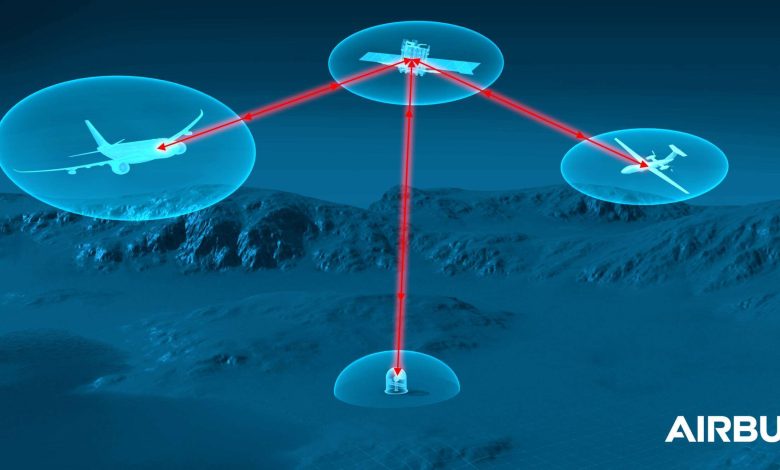
The UltraAir terminal will facilitate laser connections between an aircraft and a satellite residing in geostationary orbit 36,000 km above the Earth, leveraging cutting-edge technology that includes a highly stable and accurate optical mechatronic system. This technology demonstrator will lay the foundation for a future UltraAir product, enabling data transmission rates that could achieve several gigabits per second while ensuring anti-jamming capabilities and a low probability of interception. Consequently, UltraAir will not only empower military aircraft and UAVs (Unmanned Aerial Vehicles) to connect within a combat cloud but also, in the long run, allow airline passengers to establish high-speed data connections via Airbus’ SpaceDataHighway constellation. Positioned in geostationary orbit, the SpaceDataHighway (EDRS) satellites relay data captured by observation satellites to Earth in near-real-time, a task that would otherwise take several hours.
Airbus is spearheading this project, bringing its unparalleled expertise in laser satellite communications, honed through the SpaceDataHighway initiative. The company will oversee the terminal’s development and testing both on the ground and in flight. As a key collaborator in the project, TNO contributes its proficiency in high-precision opto-mechatronics, supported by the advanced Dutch high-tech and space industry. Airbus Defence and Space in the Netherlands will handle the industrial production of the terminals, while Airbus’ subsidiary Tesat will leverage its technical know-how in laser communication systems and participate in all testing phases.
The initial tests are scheduled to commence at the end of 2021 in laboratory conditions at Tesat. Following this, ground tests will begin in early 2022 in Tenerife (Spain), establishing connectivity between an UltraAir demonstrator and the laser terminal aboard the Alphasat satellite through the ESA Optical Ground Station. For final validation, the UltraAir demonstrator will be integrated onto an aircraft for flight testing by mid-2022.
With the escalating demand for satellite services, traditional satcom radio-frequency bands are facing capacity challenges. Laser links provide the additional advantage of minimizing interference and detection; relative to the congested radio frequencies, laser communication is significantly harder to intercept due to its much narrower beam. Consequently, laser terminals can be lighter, consume less energy, and offer superior security compared to radio communication.
This innovative program marks a pivotal milestone in Airbus’ comprehensive strategy to advance laser communications, positioning this technology as a crucial differentiator for delivering Multi-Domain collaboration for government and defense clients.