

Navantia Proposes F-110 Frigates to Meet Hellenic Navy’s Demands
Navantia, a prominent Spanish shipbuilding entity, unveiled its multi-billion euro proposal for the frigate requirements of the Hellenic Navy last Friday, the 21st of May. The submission merges a robust technical product portfolio centered on its latest naval vessel advancements with a pledge to maximize construction and launching on Greek territory in collaboration with the local industry, while mitigating risks.
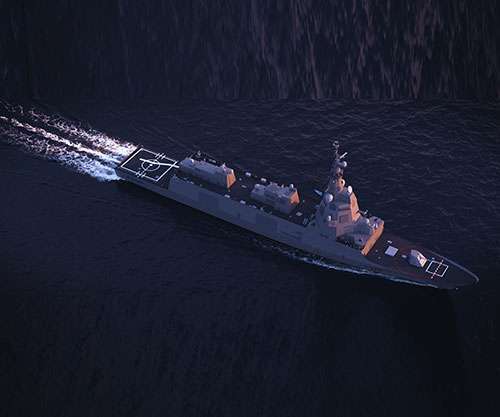
Navantia has pledged to deliver 4 new frigates for the Hellenic Navy fleet and to modernize the Hydra Class according to the stringent Hellenic Navy timeline. The new vessels comprise their latest intelligent frigate design, the F-110, which is anticipated to serve as the backbone of the Spanish Navy. The F-110 incorporates leading-edge naval innovations alongside its pioneering production and operational functionalities. These enhancements encompass complete interoperability with European and US systems, state-of-the-art weaponry, and the utilization of a “digital twin” for operational simulation and assessment.
Navantia will collaborate with the Greek shipbuilding sector and will enhance the ecosystem of technology innovators, engineering firms, industrial process contractors, and suppliers of materials and equipment in Greece. As a fundamental element of the program, the Spanish shipbuilder introduced an ambitious Technology and Capabilities Transfer (ToT) plan aimed at rejuvenating Greek shipbuilding proficiency. The ToT initiative not only includes industrial partnerships but also fosters collaborations with universities and centers of excellence focusing on innovation and workforce enhancement. This strategy is supported by the firm’s extensive experience in building capacities for partner nations, including Australia, Norway, and the Kingdom of Saudi Arabia. Navantia also intends to drive essential investments to revitalize Greek shipyard assets, fostering a sustainable source of employment and economic development for Greece.
To fortify its connections with the Greek industry, Navantia is inaugurating an Industry Day web platform on the 9th of June to engage with the Greek shipbuilding and industrial ecosystem, welcoming local companies of various types and sizes. Its objectives include outlining the program aims, facilitating opportunities for Greek entities to engage one-on-one with Navantia, and finalizing collaboration agreements.
“It is with immense pride that we present to Greece our most advanced frigate, the F-110, which signifies a technological advancement in capabilities that has already captured international attention,” stated Navantia’s Executive Chairman, Ricardo Domínguez.
“Navantia possesses extensive experience in technology transfer and capability development with partner nations, as demonstrated in Australia, Norway, and, more recently, Saudi Arabia. Our proven track record in this domain and our commitment to collaborate with Greek industry significantly enhance the value of our proposal,” remarked Javier Herrador, Commercial and Business Development Vice President.
The Spanish shipbuilder NAVANTIA stands as a global leader in the design, construction, and integration of highly advanced state-of-the-art warships for the Spanish Navy, establishing it as a strategic firm in the international arena. Its portfolio includes the design and fabrication of Integrated Platform Management Systems, Fire Control Systems, Command and Control systems, Propulsion Plants, and through-life support for its entire range of products. NAVANTIA has also undertaken initiatives to diversify and has emerged as a significant player in the offshore wind power sector.
NAVANTIA is part of Grupo SEPI, a corporate holding consisting of a total of 15 state-owned enterprises in which it holds a direct majority stake and which provide employment to over 78,000 professionals.