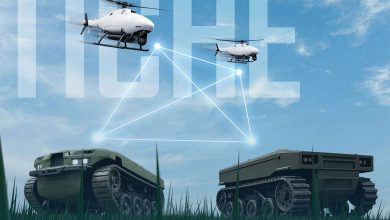

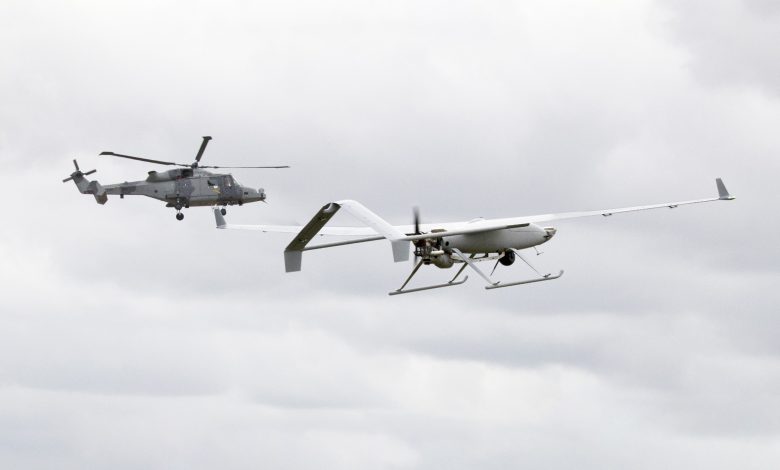
Leonardo has showcased groundbreaking integrated capabilities between a manned aircraft and an unmanned aerial vehicle (UAV) in the UK. This remarkable demonstration occurred during Manned-Unmanned Teaming (MUMT) trials, utilizing a Leonardo AW159 Wildcat helicopter paired with a semi-autonomous UAV from Callen-Lenz Associates.
MUMT refers to the innovative approach where a helicopter crew can control a UAV as if it were an onboard sensor directly from the cockpit. By seamlessly integrating UAV control into the Wildcat Mission System, Leonardo effectively reduces pilot workload, enabling them to concentrate on mission objectives while simultaneously operating the UAV. This integration marks a significant milestone, as it is the first instance of such a capability being demonstrated on a military aircraft in the UK. The interface was facilitated by a ‘Gateway Processor’ provided by Callen-Lenz Associates.
The Leonardo solution empowers the Wildcat crew to manage both the UAV’s flight path and payload — a feature recognized as Level of Interoperability (LOI) 4. This is achieved through an efficient Human Machine Interface (HMI) designed for task optimization, contrasting with the more labor-intensive methods seen in other systems.
Combining manned and unmanned platforms, MUMT is poised to significantly enhance operational effectiveness by improving situational awareness, tempo, lethality, survivability, and combat mass of aviation forces, while notably decreasing crew workload and allowing pilots to stay focused on the mission.
The integration of manned aircraft with unmanned aerial systems within MUMT elevates air support capabilities across both Land and Maritime environments. It facilitates the execution of extended and complex operations through a blend of various platforms and systems.
This demonstration formed part of the British Army’s MUMT-themed Army Warfighting Experiment (AWE) 19, meticulously planned and executed by Dstl, taking place on Salisbury Plain in September.
Building on simulation-based development under the Dstl-funded AMS DE-RISC program, this successful demonstration is anticipated to guide the MUMT capability roadmap for both the UK MoD and Leonardo.
According to Nick Whitney, Managing Director of Leonardo Helicopters (UK), “The success of this manned-unmanned trial emphasizes that Leonardo and the UK MoD are collaborating on the future of UK rotorcraft engineering, showcasing the value of a long-term partnership in capability development.”
Bryan Finlay, Technical Partner at Defence Science and Technology Laboratory (Dstl), remarked, “Leonardo and Callen-Lenz have achieved an outstanding demonstration by integrating a UAV control station into the Wildcat helicopter’s mission management system. The intelligent design of the human machine interface effectively manages cockpit workload, successfully de-risking the technology. This is a crucial step in realizing a robust operational MUMT capability.”
Maj Benjamin Thomas, Military Adviser Platform Systems Division at Dstl, commented, “The progression of the Wildcat integrated MUMT solution has been exceptional, culminating in a successful demonstration at AWE 19 through a series of representative military scenarios. MUMT indeed has the potential to revolutionize aviation capabilities in the Land environment, enhancing both situational awareness and survivability.”
Ongoing development and integration of advanced solutions across all domains of autonomously operated and semi-autonomous systems, including MUMT, is a critical component of Leonardo’s BeTomorrow2030 Strategic Plan. Leonardo leads the charge in rotorcraft development in the UK from its Yeovil facility, which stands as the nation’s only comprehensive helicopter manufacturer. With over 100 years of experience, Leonardo remains committed to delivering high-tech aircraft and capabilities to the British Armed Forces.