
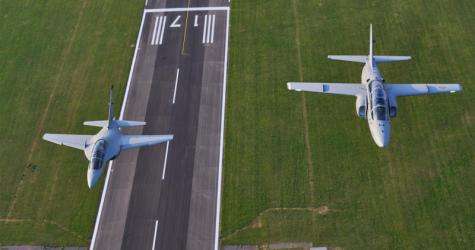
At the forefront of military pilot training, Leonardo is proudly showcasing its unique offerings with the M-345 (R) and M-346 (L) jet trainers. These aircraft represent the only complete training system globally, covering every phase from the fundamental to pre-operational stages, all through proprietary products.
Leonardo’s commitment to developing an integrated training framework utilizes both platforms and a comprehensive ground-based training system. This system comprises an array of advanced training tools, including multimedia lessons, flight and mission simulators that vary in complexity, mission planning tools, and a robust training management system.
An integrated training solution, Leonardo’s system can also function in Live, Virtual, Constructive (LVC) mode, facilitating shared scenarios across aircraft, simulators, and ground stations.
Moreover, the innovative features of the M-346 enable Leonardo to offer specialized solutions for “aggressor” training. This capability is essential for frontline fighter pilots, ensuring rigorous readiness training while managing costs effectively compared to utilizing frontline aircraft.
During the 2020 Military Flight Training Conference, Enrico Scarabotto, Head of Flight Test Operations, and Emanuele Merlo, Head of LoB Trainers in the Aircraft Division, elaborated on Leonardo’s training vision.
“The shifting geopolitical landscape, tightening defense budgets, and rapid technological advancements are transforming military flight training, presenting new challenges and opportunities,” Emanuele Merlo emphasized.
Leonardo recognizes the necessity to integrate advanced technologies appealing to Millennials during the primary and basic training phases of pilot development. This includes leveraging multimedia and simulation tools such as virtual and augmented reality systems, haptic interfaces, and more sophisticated training aircraft than those currently utilized.
Merlo stated, “Our Integrated Training System (ITS), centered around the M-345 single-engine jet training aircraft, enhances initial screening results, reduces the time needed to assess pilot capabilities for future aircraft assignments, and allows the aircraft to serve multiple purposes, including advanced and aerobatic training.”
Looking ahead, Scarabotto noted, “In the advanced and lead-in fighter training phases geared towards next-generation aircraft, effective platforms must provide superior agility, exceptional maneuverability, and advanced systems. This includes digital avionics, Helmet Mounted Displays (HMDs), and the Embedded Tactical Training System (ETTS) for optimal performance in LVC scenarios.”
The M-346 advanced jet trainer emerges as the go-to solution, boasting cutting-edge capabilities necessary for developing highly qualified pilots and aligning with future aircraft training needs.
Technologies like artificial intelligence and augmented reality are set to enhance training methodologies, incorporating extensive data processing into the training curriculum across all phases, ensuring pilots remain proficient.
Maintaining pilot proficiency necessitates advanced training against realistic adversaries, rather than solely training against similar or obsolete aircraft. Scarabotto asserts, “It’s crucial to transition to net-centric operational scenarios that simulate high-performing, ‘low-observable’ adversaries. Advanced training aircraft equipped with ETTS and LVC systems will ensure we’re prepared for the complexities of modern engagements while keeping operational costs manageable.”
The M-346FA stands out as a next-generation aggressor aircraft, capable of generating dynamic virtual scenarios and assisting in live training through its advanced radar and self-protection system.
“Integrating ETTS/LVC technology into operational squadrons allows advanced training aircraft to simulate threats effectively, significantly enhancing training outcomes, particularly in intricate scenarios similar to renowned Red Flag exercises,” Scarabotto continued.
Another core benefit of employing advanced training aircraft is their role as ‘Companion Trainers’. “Operational pilots can utilize Companion Trainers for up to half of their flying hours annually, drastically reducing costs compared to frontline fighters which can be ten times more expensive to operate,” Scarabotto explained. However, it is imperative that these trainers accurately replicate the performance and systems of frontline aircraft.
By utilizing high-performance aircraft focused on virtual reality training, Leonardo aims to maintain mission readiness at a reduced cost. The M-346FA is perfectly positioned for this role, delivering speed, agility, essential sensors, and cost-efficiency.
“In the near future,” Merlo concluded, “the evolution of networking technologies and artificial intelligence will facilitate the development of a global joint Integrated Training System (ITS). This system will unify operations across air, land, and sea, dynamically integrating real and virtual participants into a cohesive net-centric operational framework.”