



**Dr. Jason Levin**
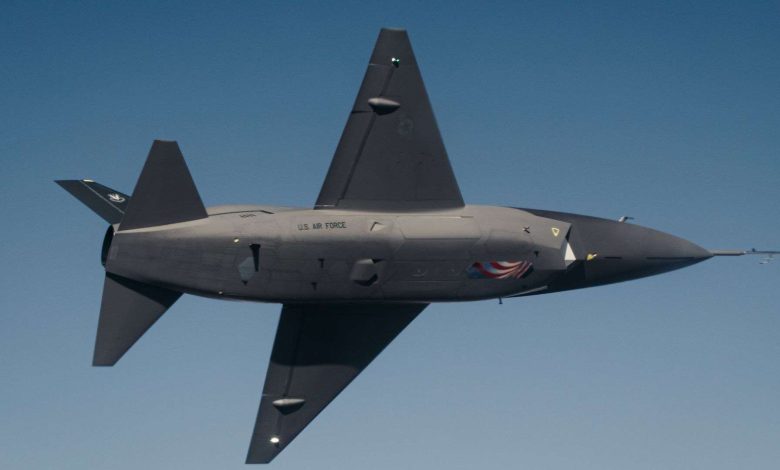
Just four months ago, the inaugural flight of Anduril’s YFQ-44A heralded a pivotal moment in aviation history, marking the first semi-autonomous flight of a fighter-class Collaborative Combat Aircraft.
Today, Anduril celebrates another remarkable achievement for the U.S. Air Force’s Collaborative Combat Aircraft (CCA) program. The YFQ-44A successfully flew with two distinct mission autonomy software suites, developed by separate vendors, all within a single flight. The aircraft autonomously took off, approached a designated point, and activated Shield AI’s Hivemind software to execute a series of test cards. Upon completing these tests, Anduril transitioned seamlessly to its own Lattice for Mission Autonomy software to fulfill additional test points before landing safely.
This flight test exemplifies the rapid advancements in the program: Anduril was selected to produce CCA prototypes in April 2024, achieved semi-autonomous flight just 556 days later, and now operates multiple aircraft on a regular basis. The successful integration of an externally developed autonomy stack signifies a substantial technical milestone, achieved swiftly due to the early incorporation of the Autonomy Government Reference Architecture (A-GRA) on both the YFQ-44A and the different software suites. This integration propels the program into critical new testing phases, including detailed mission concept operations (CONOPs), weapons integration, multi-aircraft flights, and collaboration with crewmanned fighters.
Hivemind
In recent months, the YFQ-44A team at Anduril has collaborated closely with Shield AI to integrate the Hivemind autonomy software suite into the CCA. Our shared commitment to rapid software development and technological maturity has facilitated a smooth collaboration during this vital phase of testing and improvement.
Engineers from both Anduril and Shield AI have actively worked together to merge Hivemind with the flight control software on the YFQ-44A. Extensive software-in-the-loop simulations and hardware-in-the-loop test events have built confidence in the system’s performance leading up to the mission autonomy flight.
The outcome? During the flight test, Hivemind effectively navigated the YFQ-44A through a complex series of test points, accurately simulating future mission CONOPs. This successful performance validates our collaborative approach to integration, development, and testing, and we are excited to continue advancing our work with the Shield AI team in the coming months.
Lattice for Mission Autonomy
The U.S. Air Force’s CCA program emphasizes ongoing competition, modularity, and the swift integration of best-in-class hardware and software capabilities. This philosophy extends to mission autonomy software, where a universal Autonomy Government Reference Architecture (A-GRA) standard has been established to cultivate a competitive and innovative software ecosystem.
Over the past year, Anduril has committed significant resources and assembled a dedicated team to develop the Lattice for Mission Autonomy software baseline, with a singular mission: to create the ultimate solution for air dominance. This fervent focus has driven unparalleled execution across our team, as we believe this capability must exist at the highest standards.
This flight with the YFQ-44A signifies a considerable milestone for the Lattice for Mission Autonomy initiative. We understand that our work is merely beginning, and we remain dedicated to enhancing both the capability and the trust of warfighters in the system.
Modularity Unlocks Capability
YFQ-44A has been engineered as a highly modular and adaptable aircraft. Its straightforward design and open hardware and software architectures allow easy configuration with diverse mission systems, software suites, and payloads to fulfill various missions.
The successful integration of dual mission autonomy software suites into one YFQ-44A sortie serves as a testament to its modularity. Moreover, it confirms the program’s strategic acquisition approach: by prioritizing open architectures, the CCA initiative has cultivated a competitive marketplace of software providers, catering to evolving mission requirements.
Together with our U.S. Air Force partners and industry allies, we are making crucial strides towards a new era in military aviation, characterized by mass, autonomy, affordability, flexibility, and speed. From initiating production at Arsenal-1 to validating the YFQ-44A in increasingly complex mission scenarios, we eagerly anticipate what lies ahead.