


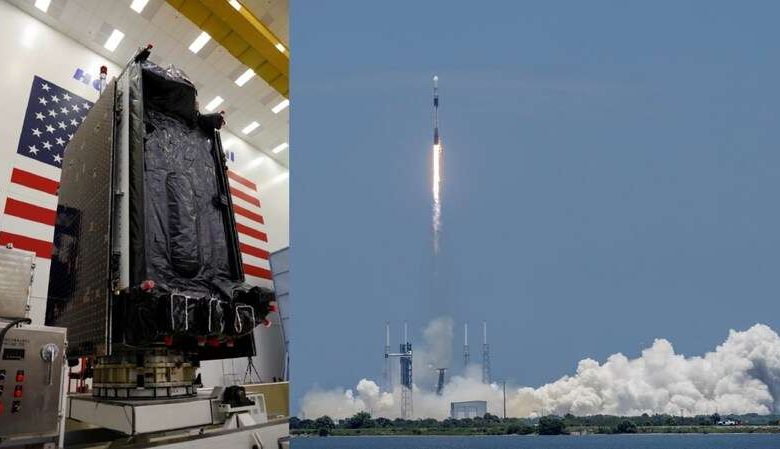
“Reaching New Heights: Lockheed Martin Unleashes Its Cutting-Edge GPS III Satellite”
At 1:37 p.m. EDT today, the eighth GPS III spacecraft—designed and produced by Lockheed Martin (NYSE: LMT)—successfully launched from Cape Canaveral Space Force Station, Florida. It achieved signal acquisition shortly thereafter.
Similar to its rapid predecessor in December 2024, GPS III SV08 implemented a quick launch timetable, leaving its cleanroom in Colorado and commencing launch preparations in Florida within just over three months, contrasting with the typical schedule that spans several months.
“Our team is thrilled to facilitate yet another launch of a vital GPS satellite, just five months post the previous liftoff,” remarked Malik Musawwir, Vice President of Navigation Systems for Lockheed Martin Space. “This exemplifies Lockheed Martin’s proficiency in rapidly launching and deploying critical national security space assets, and we are keen to position the next two GPS III satellites into orbit to enhance this crucial constellation.”
The GPS III satellites will play a pivotal role in providing precise and robust positioning, navigation, and timing (PNT) services to both civilian and military personnel, enabling essential functions like aviation, maritime, and land transport, in addition to search and rescue operations. For military users, the enhanced security features and anti-jamming capabilities of GPS III—and the forthcoming GPS IIIF—satellites are particularly significant, assuring continuous access to accurate navigation and timing data, even in contested or hostile territories, thus strengthening national security and defense strategies.
SV08 is currently under active supervision at Lockheed Martin’s Denver Launch & Checkout Operations Center until it receives formal acceptance into the current operational GPS network.
Ground Operations for Space Security
Beyond the manufacturing of the spacecraft at its Littleton, Colorado facility, and offering early operational support in orbit, Lockheed Martin plays a crucial role in the sustainment and maintenance of the advanced GPS ground segment—often referred to as the Architecture Evolution Plan.
This framework is integral to managing the 31 active GPS satellites in orbit, enabling them to provide transformative PNT services that our modern world relies on.
The ground segment, backed by Lockheed Martin, is accountable for monitoring and controlling the GPS satellite constellation, while supplying navigation data to its users. It consists of a network of monitoring stations, master control centers, and global ground antennas.
Recently, Lockheed Martin has further enhanced GPS’s ground segment by incorporating M-Code Early Use into the framework, facilitating worldwide access to a specialized, secure military communications signal for U.S. and allied forces.
Once declared operational, GPS III SV08 will be the eighth GPS III satellite in orbit with enhanced M-code, bolstering navigation, accuracy, and anti-jamming capabilities for critical military missions.
Lockheed Martin was also recently awarded a contract modification for two additional future GPS IIIF satellites to further expand the constellation.