


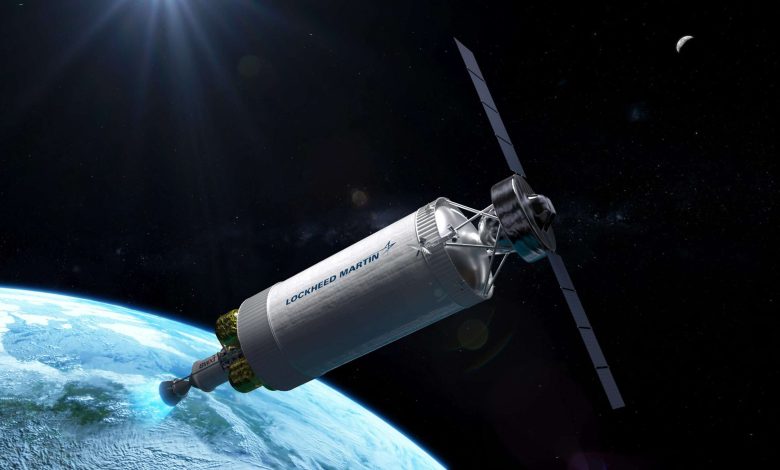
Lockheed Martin Chosen to Build Revolutionary Nuclear-Powered Space Vessel
Lockheed Martin has secured a contract from the Defense Advanced Research Projects Agency (DARPA) to engineer and validate a nuclear-powered spacecraft under the initiative termed Demonstration Rocket for Agile Cislunar Operations (DRACO). This endeavor will illustrate a swift progression in propulsion technology to enhance exploration and bolster national defense.
DARPA collaborated with NASA’s Space Technology Mission Directorate on the DRACO initiative, as both organizations will gain from this avant-garde technology. The in-space flight validation of a nuclear thermal rocket engine vehicle is slated to occur by 2027 at the latest.
Speedier, Farther, More Agile
Chemical propulsion systems have traditionally dominated space travel, but for humanity to venture to Mars, far more potent and efficient propulsion is necessary. Nuclear thermal propulsion (NTP) systems provide thrust comparable to traditional chemical propulsion, boasting two-to-five times greater efficiency, allowing the spacecraft to journey faster and farther while significantly lessening propellant requirements. They also facilitate abort scenarios on trips to Mars that chemical propulsion systems cannot accommodate.
“These advanced and efficient nuclear thermal propulsion systems can offer reduced transit times between locations. Minimizing transit duration is crucial for human missions to Mars to limit crews’ exposure to radiation,” stated Kirk Shireman, vice president of Lunar Exploration Campaigns at Lockheed Martin Space. “This is an essential technology that can be leveraged to transport humans and supplies to the Moon. A reliable, reusable nuclear tug spacecraft would transform cislunar operations. With enhanced speed, agility, and maneuverability, nuclear thermal propulsion also has numerous applications for national security within cislunar space.”
Safe and Efficient Nuclear Technology
An NTP system employs a nuclear reactor to rapidly heat hydrogen propellant to extremely high temperatures, then channels that gas through the engine nozzle to generate significant thrust. The fission-based reactor will utilize a unique high-assay low-enriched uranium, or HALEU, to convert the cryogenic hydrogen into an intensely hot pressurized gas. The reactor will remain inactive until the spacecraft reaches a nuclear-safe orbit, ensuring the NTP system is exceptionally secure.
Lockheed Martin has collaborated with BWX Technologies to design the nuclear reactor and produce the HALEU fuel.
“Over the past several years, BWXT has been advancing its nuclear thermal propulsion fuel and design, and we are eager to further extend our capabilities into space by delivering nuclear products and solutions to the U.S. Government,” remarked Joe Miller, BWXT Advanced Technologies LLC president. “We anticipate constructing the reactor and manufacturing the fuel at our Lynchburg, Virginia, facilities.”
Although nuclear systems are a burgeoning domain, Lockheed Martin boasts a rich history and expertise in nuclear controls and has constructed numerous radioisotope thermoelectric generators for NASA’s planetary missions. Lockheed Martin has also heavily invested in cryogenic hydrogen storage and transfer technology. This fundamental technology will be crucial in deep space exploration not only for NTP but also for standard propulsion systems.
Lockheed Martin Chosen To Develop Nuclear-Powered Spacecraft