




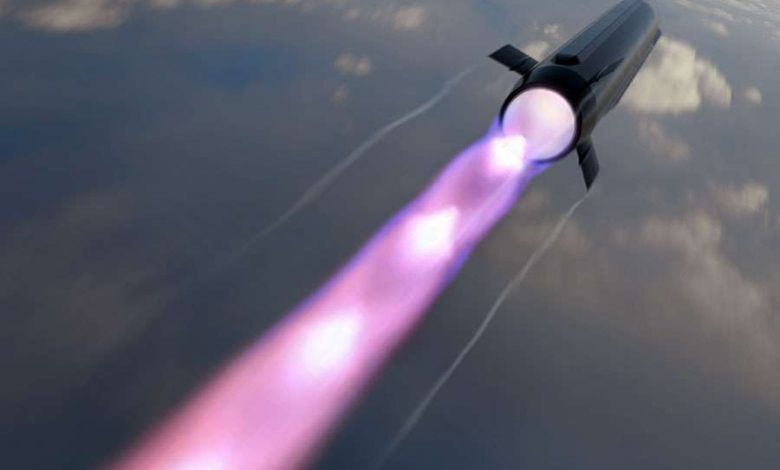
“Trailblazing the Skies: GE Aerospace and Lockheed Martin Unveil Revolutionary Ramjet Technology for Hypersonic Warfare”
GE Aerospace (NYSE: GE) and Lockheed Martin (NYSE: LMT) have successfully conducted a series of engine tests that showcase the effectiveness of a liquid-fueled rotating detonation ramjet designed for hypersonic missiles. This initiative marks the beginning of a significant partnership focused on advanced technology development.
WHY IT MATTERS
This innovative rotating detonation ramjet is set to revolutionize missile technology by providing increased speed—allowing flight at hypersonic velocities—and enhanced range while also reducing costs compared to traditional ramjet solutions. Here’s how this new technology stands out:
- Its compact design allows for greater fuel and payload capacity, contributing to lower production costs.
- Enhanced fuel efficiency coupled with thrust generation extends operational range.
- Lower speed ignition means smaller boosters can be utilized, optimizing the ramjet’s launch capabilities.
HOW IT WORKS
- The rotating detonation ramjet propels air and fuel through detonation waves, deviating from traditional combustion methods commonly employed in current ramjet engines.
- This propulsion mechanism delivers significant thrust, enabling super- and hypersonic speeds to reach vital and time-sensitive targets while maintaining a compact size that enhances range.
STRATEGIC PERSPECTIVES
“Our hypersonic capabilities at GE Aerospace are rapidly evolving, and this partnership with Lockheed Martin is another important milestone,” stated Mark Rettig, VP and GM of Edison Works Advanced Programs at GE Aerospace. “The results from the rotating detonation ramjet and inlet testing surpassed our expectations, and we are eager to push forward in evolving our advanced air-breathing hypersonic propulsion technologies.”
“After two years of committed internal investment, this demonstration highlights the strength of collaboration, innovation, and our shared goal to deliver affordable capabilities to warfighters swiftly,” remarked Randy Crites, VP and GM at Lockheed Martin Advanced Programs. “This cutting-edge ramjet harnesses Lockheed Martin’s experience in ramjet inlets, ensuring improved range at extreme speeds. We are dedicated to advancing America’s hypersonic capabilities in an increasingly challenging threat landscape.”
DIVE DEEPER
- The ramjet integrates GE Aerospace’s rotating detonation combustion system while utilizing Lockheed Martin’s tactical inlet for optimal high-speed airflow into the combustor.
- Direct connect tests simulating ramjet ignition and cruise conditions were successfully carried out at the GE Aerospace Research Center in Niskayuna, New York, proving the feasibility of an air-breathing rotating detonation ramjet for missile applications.
- Engineers conducted airflow injections into the inlet to mimic conditions of supersonic flight across varying speeds and altitudes, including testing at elevated cruising altitudes where the challenge of thin air complicates combustion efficiency.
WHAT’S NEXT
In 2026, GE Aerospace and Lockheed Martin are set to advance the maturation of the ramjet technology even further.