


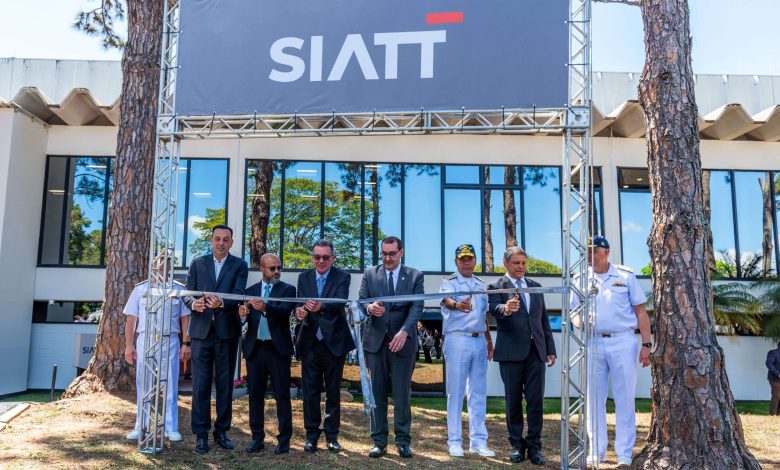
EDGE Group’s SIATT Launches Cutting-Edge Headquarters and Production Center in São José dos Campos, Brazil
The EDGE Group division SIATT, a firm located in Brazil that specializes in developing intelligent systems for defense and security, has officially inaugurated its new headquarters and manufacturing facility in São José dos Campos. The recently launched site spans 6,000 square meters and is equipped with state-of-the-art engineering spaces, research and development laboratories, and production lines, amplifying SIATT’s capability to deliver innovative defense technologies and marking a considerable advancement in its industrial capacity.
Hamad Al Marar, the Managing Director & CEO of EDGE Group, along with senior executives from EDGE, took part in the event during an extensive tour of Brazil. Prominent Brazilian officials and key stakeholders, including the Vice-Governor of São Paulo, Felício Ramuth; the Commander of the Brazilian Navy, Admiral Marcos Sampaio Olsen; the Marine Corps Commander, Carlos Chagas; and the Mayor of São José dos Campos, Anderson Farias, were present.
Hamad Al Marar stated: “EDGE is privileged to team up with SIATT as we celebrate this milestone. This signifies our inaugural investment in Brazil for 2023, and since then, we have substantially transitioned from a research and development center to a remarkable industrial complex. This exemplifies SIATT’s commitment to boosting Brazil’s technological autonomy and creating lasting benefits for its defense industry. Together, we are laying the groundwork for innovation, economic growth, and dependable partnerships.”
In September 2023, EDGE acquired a 50% stake in SIATT, reinforcing its global strategy of investing in high-growth companies. With collaboration from EDGE Group, SIATT has accelerated its expansion journey, enhanced its export readiness, and positioned itself as a crucial participant in both the Brazilian and global defense industries. The new establishment in São José dos Campos is projected to generate 200 direct job opportunities along with an additional 600 indirect employment roles.
Founded in 2015, SIATT concentrates on the development and incorporation of defense and security systems, including missile technologies, armaments, and advanced embedded tech solutions. Over the past decade, it has forged strategic partnerships with the Armed Forces and industry leaders, contributing to projects of national significance and cultivating a highly specialized skill set.
Among its notable projects are the innovative Mansup anti-ship missile, the extended range Mansup-ER, the advanced precision Max 1.2 AC anti-tank missile, and the Blue Amazon Management System (SisGAAz), a premier initiative for coastal surveillance and maritime security.