

Pioneering the Future: U.S. Soldier Executes Groundbreaking Autonomous Black Hawk Missions with MATRIX™ Tech at Northern Strike 25-2
A Historic Milestone in Aviation
For the first time in military history, a U.S. Army soldier—rather than a trained aviator—successfully planned and executed real-world missions using Lockheed Martin Sikorsky’s Optionally Piloted (OPV) Black Hawk helicopter, equipped with cutting-edge MATRIX™ technology.
In collaboration with the Joint Personnel Recovery Agency and the Defense Advanced Research Projects Agency (DARPA), Sikorsky showcased the OPV Black Hawk during Northern Strike 25-2 this past August. This operational environment demonstration highlighted how an autonomous Black Hawk can enhance mission effectiveness while minimizing risks to soldiers.
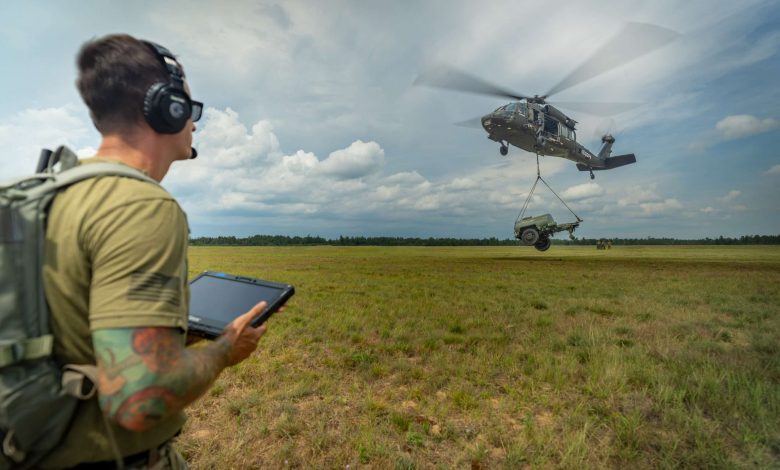
A U.S. Army National Guard Sergeant First Class, who underwent training in under an hour, became the first soldier to independently plan and execute OPV Black Hawk missions utilizing a handheld tablet. He directed the payload to a target 70 nautical miles away and oversaw multiple precision airborne drops, marking a significant achievement as the OPV Black Hawk operated fully under the command of a warfighter rather than a trained pilot or engineer.
Innovations in Autonomous Flight
At Northern Strike, the OPV Black Hawk demonstrated several groundbreaking cargo delivery techniques, including internal carry, external sling load, and precision parachute drop capabilities, alongside a medevac exercise.
- Exercise 1: Parachute Drops and Logistics Recovery
- From a Coast Guard vessel on Lake Huron, the soldier executed a Class 1 resupply mission from 70 nautical miles away. Upon unloading the cargo, he used the tablet to navigate the OPV Black Hawk in racetrack patterns, facilitating two precision parachute drops at various altitudes. This operation marked the first instance of the OPV Black Hawk performing logistics and airborne drops entirely under soldier command.
- Exercise 2: Water Buffalo External Sling Load
- The OPV Black Hawk successfully completed its first autonomous hookup of an external load while airborne. With its hover stability capabilities, the aircraft maintained position as soldiers efficiently attached a 2,900-pound water tank, demonstrating that a MATRIX-equipped aircraft is capable of complex aerial resupply missions.
- Exercise 3: HIMARS External Sling Load and Medevac Recovery
- The OPV Black Hawk performed six autonomous hovering hookups to transport HIMARS launch tubes to a designated landing zone. Subsequently, a soldier conducted a simulated personnel recovery, achieving a tail-to-tail patient transfer to a piloted Black Hawk at an unimproved landing site. This marked the first time an untrained soldier managed an autonomous medevac recovery from within the OPV Black Hawk.
“With lives on the line, Sikorsky’s MATRIX flight autonomy system has the potential to revolutionize the way military operators accomplish their assignments,” stated Rich Benton, vice president and general manager of Sikorsky, a Lockheed Martin company. “An optionally piloted Black Hawk can alleviate pilot workload in challenging environments or carry out resupply missions without crew onboard. In contested logistics scenarios, a Black Hawk functioning as a large drone provides commanders enhanced resilience and flexibility in resource delivery.”
MATRIX technology, utilized to support DARPA’s Aircrew Labor In-cockpit Automation System (ALIAS), empowers operators by granting them control over sophisticated aviation systems—capabilities that were once limited to trained pilots. This technology enables missions such as resupply, personnel recovery, and logistics in high-risk or poor visibility conditions, maximizing safety.
As a reliable partner to joint military services, Sikorsky is dedicated to delivering future-ready solutions that broaden warfighter capabilities. This pioneering achievement at Northern Strike underscores Sikorsky’s commitment to shaping the next generation of agile and adaptable aircraft systems.