

“U.S. Space Force Bolsters Defense with LRDR Acquisition”
Significant Milestone in Missile Defense: U.S. Space Force Accepts Lockheed Martin’s Long Range Discrimination Radar (LRDR)
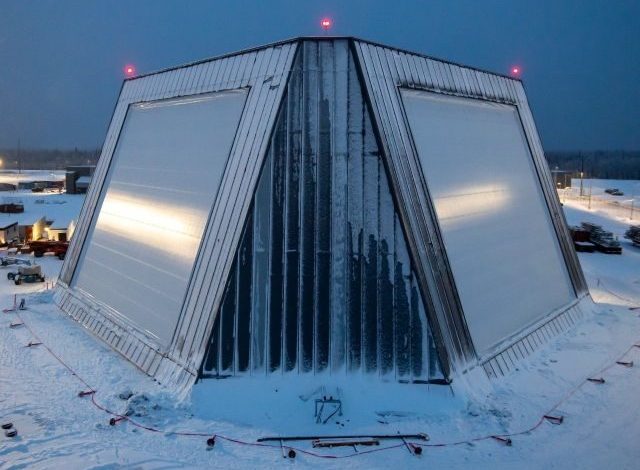
In a pivotal advancement for missile defense, the U.S. Space Force has officially integrated Lockheed Martin’s Long Range Discrimination Radar (LRDR) at Clear Space Force Station in Alaska. Following the successful Missile Defense Agency (MDA) testing, this integration fortifies the U.S. national missile warning and tracking systems amid escalating long-range threats.
The U.S. Space Force confirmed that the LRDR is now an integral part of the nation’s missile warning, tracking, and targeting mission, enhancing overall defense capabilities. Lockheed Martin has verified the completion of the final acceptance DD250 and the transfer of the system to the MDA, highlighting the radar program’s readiness for national defense missions.
LRDR: A Transformative Force in Missile Defense for the Middle East
The Middle East has long been a crucial hub of global trade, technological advancements, and defense strategies. As the region modernizes its security frameworks, it faces increasing missile threats characterized by rapid technological advancements, evolving tactics, and new forms of warfare.
Threats range from short- and medium-range ballistic missiles to emerging hypersonic systems and precision-guided munitions. The need for continuous situational awareness is paramount—requiring a robust defense network capable of detecting, tracking, and responding before any missile penetrates regional airspace.
Effective defense hinges on clear visibility, precise knowledge, and decisive action. This is where Lockheed Martin’s Long Range Discrimination Radar (LRDR) plays a vital role.
Enhanced Detection and Response
At its core, LRDR is a high-performance, S-band radar utilizing advanced solid-state gallium nitride (GaN) technology. It merges wide-area surveillance with high-resolution tracking and discrimination, enabling operators to identify, monitor, and differentiate real threats from decoys, debris, and countermeasures in challenging environments.
Designed for relentless operation—even during maintenance—LRDR guarantees 24/7 readiness. Its modular, software-defined architecture facilitates rapid updates and seamless integration with other defense systems, ensuring it remains relevant as threats evolve.
LRDR serves not just as a sensor but as an intelligence hub providing decision-makers with the advantage to see further, act faster, and respond effectively.
- Early and Continuous Tracking: Critical reaction time and situational awareness from launch to midcourse.
- High-Fidelity Discrimination: Engaging only verified threats to optimize resources and efficiency.
- Open Architecture: Clear paths for future upgrades and integrations to address emerging challenges.
- Simultaneous Multi-Mission Capability: Ensures no delays in transitioning threats from surveillance to fire control.
Discrimination, Deterrence, and Defense
While traditional radars can identify missile launches, LRDR excels in discrimination. Its ability to discern which objects within a cluttered environment present real threats is its most significant asset.
Modern missiles often deploy decoys or separate into multiple stages to overwhelm conventional sensors. LRDR’s precision algorithms and advanced signal processing provide clarity essential for modern missile defense, resulting in three key advantages:
- Resource Efficiency: By engaging only confirmed threats, LRDR minimizes unnecessary interceptor launches, conserving resources and lowering operational expenditures.
- Operational Confidence: High-accuracy discrimination enables quicker, more informed decision-making, minimizing false alarm risks.
- Stronger Deterrence: As adversaries realize their warheads will be accurately tracked, the likelihood of missile strikes decreases.
Custom Solutions for Regional Defense: LRDR-ME
Understanding the unique security dynamics of the Middle East, Lockheed Martin developed LRDR-ME, a variant tailored to meet regional needs.
Employing the robust S-band GaN-based radar core, LRDR-ME is optimized for local conditions and designed for seamless integration with existing and planned defense systems. Operating continuously—around the clock—this system utilizes advanced software algorithms for precise tracking and discrimination over considerable distances.
When partnered with systems like THAAD (Terminal High Altitude Area Defense), LRDR-ME creates a truly layered missile defense architecture, capable of detecting and engaging ballistic missiles at various ranges and altitudes, ensuring comprehensive operational effectiveness. This integration represents significant progress in multi-domain defense capability and contributes to regional stability.
Strategic Advantages for Regional Security
The benefits of LRDR-ME extend far beyond its technical capabilities; it reshapes strategy and resilience throughout the defense ecosystem.
- Early Warning and Extended Range: Long-range detection provides crucial minutes for nations to activate defenses, alert populations, coordinate with allies, and deploy countermeasures, translating time saved into heightened stability.
- Advanced Tracking: With regional actors investing in next-generation missile systems, including hypersonic capabilities, LRDR’s adaptable software ensures it remains effective against high-speed, maneuverable threats.
- Integration Across Defense Networks: Many Middle Eastern countries operate multi-layered air and missile defense systems. Acting as a long-range sensor, LRDR-ME enhances this framework by integrating seamlessly with interceptors, naval assets, and command networks for improved accuracy and reduced operational load.
You Can’t Combat What You Can’t Detect.
The missile threat landscape in the Middle East is dynamic and sophisticated. Effective defense requires not only strategic insight but also operational clarity. LRDR embodies this necessity: a system that provides enhanced visibility, rapid understanding, and continuous adaptability to shifting security challenges.
For nations in the region, adopting this capability represents a pivotal step toward credible deterrence, regional stability, and lasting security in an unpredictable landscape.