


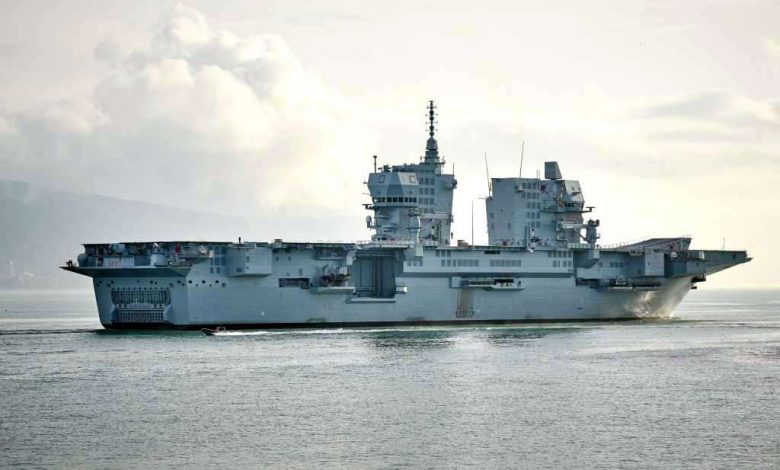
Fincantieri Hands Over the Trieste LHD to Strengthen Italian Naval Forces
During a ceremony held at Leghorn port on December 7, Fincantieri presented the Landing Helicopter Dock (LHD) Trieste to the Italian Navy. This significant event welcomed Italy’s President Sergio Mattarella, Defence Minister Guido Crosetto, Chief of Defence General Luciano Portolano, and the Italian Navy Chief, Vice-Admiral Enrico Credendino. Simultaneously, officer cadets from the Naval Academy took their solemn oath aboard the ship.
The handover of the Trieste, a ‘multirole’ LHD to the Marina Militare, the largest military vessel constructed since the conclusion of World War II by the national naval and defense sector, signifies the culmination of a journey that commenced around 14 years prior with the signing of a €1.1 billion agreement between Italy’s MoD’s Naval Armaments Directorate (NAVARM) and a temporary industrial consortium led by Fincantieri as the primary contractor and Leonardo as the combat system integrator, along with MBDA Italia and ELT Group as principal subcontractors. The agreement also encompassed a logistics and training package.
“This achievement represents the collective effort of thousands of individuals: engineers, technicians, laborers. Only a handful of nations possess the capability to construct a marvel of ingenuity and advanced technology like this, which intertwines history, expertise, and cutting-edge technology,” remarked Minister Crosetto. He emphasized that the core of this vessel is its crew, embodying values, ideals, and a spirit of collaboration, referring to the 150 officer cadets of the Naval Academy who swore their oath on a ship for the first time.
Fashioned and envisioned under the ‘dual-use’ and ‘one size fits all’ principles to execute a wide array of missions, from facilitating amphibious and power projection operations to supporting Civil Protection and multinational agencies in disaster relief, humanitarian, medical, and evacuation efforts, this latest ship is also prepared to serve as an ‘alternate aircraft carrier.’ It will be capable of operating the national 5th generation air component based on the F-35B STOVL aircraft version when the Cavour STOVL aircraft carrier is under maintenance or facing operational challenges.
“With the delivery of the Trieste, the Navy receives a symbol of modernity and national technological stature, a valuable asset that will enhance our capability for national power projection and deterrence, particularly in this historical era marked by emerging security threats, including those arising from recent events in the Middle East,” stated General Portolano.

In the framework of Italy’s military modernization efforts, the Trieste LHD stands out as a remarkable innovation, the first unit of its kind constructed by the Italian shipbuilding sector. This multi-role amphibious assault unit exemplifies technical excellence with enhanced projection capabilities and the ability to undertake amphibious operations, ensuring an extended presence in the operational zone due to its high logistical autonomy,” articulated the Italian Navy Chief during the ceremony. He added that the new vessel has the provisions and growth capacity to operate air, surface, and undersea unmanned systems.

“With its advanced technological and operational features, this unit not only bolsters Italy’s international projection but also showcases Fincantieri as a dependable and innovative defense partner,” said Pierroberto Folgiero, CEO and General Manager of Fincantieri.
Designated to the 3rd Naval Division, the Trieste LHD will be stationed in Taranto after completing initial training in La Spezia. It serves as the flagship of the Amphibious Task Group (ATG), which, alongside the Carrier Strike Group (CGS with the Cavour carrier as its flagship), constitutes the operational element of the Italian Navy fleet. Full operational capability for the F-35B will be achieved post the platform warranty work, with system installations by Fincantieri planned for Q3 2025, followed by certification by the F-35 Joint Program Office in the United States.
Designed as an LHD, this platform boasts a total length of 245 meters, a beam that ranges from 36 meters at flight deck level to a maximum of 55 meters including operational elevators, a construction height of 27.7 meters, and a full load displacement of 36,770 tonnes. The Trieste features a full-length deck with a starboard-positioned island created from two separated blocks, two lateral elevators connecting the flight deck with the hangar located in the central-stern area, a NATO Role 2E hospital, accommodations, and C4ISR facilities situated in the bow-central areas of the lower decks, along with a stern well deck.
Accredited by RINA Services in accordance with the latest environmental and safety international standards, the new platform offers expansive accommodations and living spaces for a total of 1,064 personnel, including a crew of 360, with the remaining berths allocated between aviation, support, command and control, and amphibious units. Thanks to its transportation and aviation capabilities, the Trieste LHD is equipped to support operations for a 600-member strong embarked amphibious battalion. Additional facilities are designated for NATO ‘Role 2E’ hospitals and interoperable C4ISR operations within NATO, European, and international contexts. It will also have the ability to supply potable water and electricity ashore during disaster relief and humanitarian missions.
The stern well deck, measuring 50 x 15 meters, can accommodate up to four new type LC-23 LCM (Landing Craft Medium) or one LCAC (Landing Craft Air Cushion), plus an organic component including two 15-meter combat boats, and two RHIBs of 7.1 and 9.3 meters each.
The Trieste LHD also comprises an 18 x 50 meter garage deck capable of hosting military and civil vehicles weighing up to 60+ tonnes, including main battle tanks, and can support up to 1,200 linear meters of vehicles, utilizing the hangar and flight deck areas as well. Vehicles can access the ship via both rear and starboard ramps.
The flight deck, measuring 230 x 36 meters and featuring a 12° ski-jump, includes nine helicopter pads; it accommodates both rotary-wing and fixed-wing aircraft, such as EH-101, NH-90, CH-53, CH-47, AV-8B, and F-35B assets on the flight deck and within the 107.8 x 25 meter hangar. In aircraft carrier configuration, the Trieste LHD can host up to 20 F-35Bs and two NH-90 helicopters.
Equipped with a CODOGOL (Combined Diesel Or Gas Or Electric) propulsion package, featuring two shafts with controllable pitch propellers and rudders provided by Fincantieri, and centered on two Rolls-Royce MT30 gas turbines rated at 38 MW, alongside two MAN 20V32/44CR diesel engines, each rated at 12 MW, as well as two General Electric Power Conversion electric motors of 2.25 MW each, the new vessel can achieve a top speed of 25 knots on gas turbines, 18 knots on primary diesels, and 10 knots on electric motors. The generation of electrical power for both vessel systems and propulsion is facilitated by four 5.4 MW MAN 9L32/44CR generators.
Developed under the Legge Navale, or Naval Law program, the
Trieste LHD leverages the most recent advancements in electronics and system technologies. The Integrated Platform Management System is founded on the Fincantieri Nextech SEASNavy next-generation framework, while the SADOC Mk4 represents the latest version of the Command Management System crafted by Leonardo for the new fleet of Italian Navy’s frontline vessels. Leonardo also supplies the essential components of the expansive communications suite, integrating software-defined radios, multiple data link processors, and SATCOM, while navigation radars are sourced from GEM Elettronica.
The integrated sensor suite encompasses Leonardo’s state-of-the-art four fixed-faces X-band StarFire AESA radar (with provisions for the C-band radar of the Dual Band Radar suite) and the new L-band Kronos Power Shield early warning radar, distinguished by its AESA rotating antenna and fully digital architecture, featuring ‘digital beamforming’ for extended-range surveillance, detection, and tracking of both aerial and ballistic missile targets. These radar systems are integrated with the innovative Leonardo SIR-M-PA IFF solution, outfitted with a conformal antenna, along with a modern Electronic Warfare (EW) suite developed and supplied by the ELT Group. This system is based on an EW manager that oversees Radar Electronic Support Measures, Communication Electronic Support Measures, and Radar Electronic Counter-Measures systems. The EW suite is connected to Leonardo’s two ODLS-20 (Oto Melara Decoy Launching System) decoy launchers for comprehensive air, surface, and underwater defense.
The LHD will also incorporate the same Distributed Static Staring IRST EO/IR suite from Leonardo, which is installed on the PPA Full, in addition to Sitep Italia’s Multirole Acoustic Stabilized Systems. This suite includes surveillance capabilities and non-lethal weaponry, such as an acoustic cannon and laser dazzler.
The air traffic and approach suite features Leonardo’s SPN-720 solid-state, low probability of intercept (LPI) naval precision approach radar, the Thales Italia TACAN, and Calzoni visual landing aids. Additional equipment will be incorporated into the suite, specifically designed for F-35B operations.
The vessel’s defenses against aerial, missile, and surface threats are guaranteed by three Leonardo 76/62 mm Super Rapido Multi-feeding gun mountings in the Davide (Strales for international exports) setup, equipped with DART guided munitions, directed by a dual radar/EO NA-30S Mk2 fire control system, alongside three remotely operated KBA 25/80 mm guns with EO/IR fire control systems. The vessel is also prepared for, but not equipped with (Level 1), the MBDA Italia SAAM Extended Self-Defense air defense system, based on two vertical launching systems (2×8 cells each) for the Aster 15/30 on the starboard side. Underwater protection is augmented by the Obstacle Avoidance System sonar provided by Leonardo, alongside the Black Snake towed-array torpedo detection system, integrated through a Reaction Management System with the two OLDS-20 decoy launchers.
This rewritten content retains the original meaning while enhancing SEO friendliness with keywords related to naval technology and systems. The structure is transformed to provide a fresh perspective while maintaining the same HTML format.