
Register To WDS
Hanwha Tanks
Register To Dimdex- Remayah Magazine
Defense CompaniesLand ForcesST Engineering

Elevating Warfare: Innovating the Future of Combat through Layered Strategies

The Future of Defence: Innovations on Display at the 2026 Exhibition Cycle

As the global defence community gears up for the dynamic 2026 exhibition cycle, the spotlight is on the integration of rapidly evolving military capabilities. Leading international events, including the World Defence Show and DIMDEX, are emerging as vital platforms for meaningful dialogue, attracting a diverse array of operational, industrial, and governmental stakeholders.

Recent exhibitions have transcended the traditional showcase format. There is now a marked focus on unmanned systems, advanced naval capabilities, and robust supply chain strategies, reflecting the complexities of modern multi-domain operations. Ongoing conflicts in Europe and the Middle East have reinforced a significant lesson: technological superiority must correlate with seamless integration, sustainability, and adaptability in real-world scenarios.

An experienced defence analyst states: “Consider a forward operating base in a chaotic urban environment. Every sound, from engines to footsteps, affects operational security. Remaining silent is not just advantageous—it’s crucial for stealth. That’s where hybrid electric drive (HED) vehicles come into play.”

Hybrid electric drive empowers military units to switch to silent electric mode, enhancing concealment during critical missions. Additionally, it provides reliable power at the point of need, supporting command posts, sensors, radars, unmanned vehicles, and electronic warfare systems without the reliance on noisy generators. This approach results in a lighter logistical footprint, extended mission duration, and increased flexibility for commanders on the front lines. The operational value lies in sustained power delivery, especially in challenging environments.

Defence exhibitions have increasingly evolved into proving grounds rather than mere showrooms. Emerging technologies like hybrid architectures, autonomy, and networked systems are changing force operations. Participants have the opportunity to discern what innovations are truly functional and what elements still pose risks.

According to a defence specialist: “Hybrid electric drive becomes invaluable when the primary engine is compromised, whether by shrapnel, debris, or electronic interference. The electric system ensures communication remains active, situational awareness is sustained, and mobility is preserved when it’s most critical.”

Significantly, acoustic and thermal signatures are minimized, facilitating low-heat ‘silent watch’ operations. For instance, on an 8×8 platform, soldiers can achieve approximately 25 km of nearly silent movement and remain on standby for up to 24 hours. This efficiency reduces fuel consumption by around 30%, alleviating pressures on supply chains. Live demonstrations at upcoming events are anticipated to illustrate both off-road effectiveness and power export capabilities under simulated conditions.

Unmanned systems are extending operational ranges significantly. The TAURUS UGV exemplifies versatility beyond mere equipment transport. With regenerative charging capabilities, it has a curb weight of 1,650 kg and a gross weight of 2,900 kg, enabling it to carry supplies, evacuate personnel, mount remote weapons, conduct surveillance, or deploy smaller drones as the situation demands. Its all-electric drivetrain delivers up to 20 kW of configurable power, establishing it as a forward energy hub. Notable features include follow-me mode, waypoint navigation, and obstacle avoidance, with capabilities of traveling up to 40 km/h autonomously or 80 km/h when towed.

Furthermore, unmanned aerial vehicles (UAVs) are revolutionizing urban warfare tactics. Platforms such as ARTOS provide real-time imagery, enhancing rapid troop responses and accelerating decision-making processes. Early situational awareness is becoming increasingly critical in complex environments.

A defence expert adds: “Beyond just what the drone detects, the speed at which commanders can respond to that information significantly alters operational effectiveness.”

Protection during operations is crucial, especially for platforms requiring swift upgrades. ARIELE offers a practical solution with modular, lightweight Passive Add-On Armour, designed for quick integration. The strategy is clear—improve survivability without hindering operational capacity.

When considering Transparent Armour, compliance with standards such as MIL-STD-810H is now commonplace among systems. What sets them apart is their weight and visibility. CleArmour’s advanced transparent ceramic technology reduces the mass of traditional glass armour by up to 50% while ensuring optical clarity, even after impact. Additionally, ARIELE’s Armour Glass follows suit, achieving a weight reduction of about 20% across STANAG Levels 1 to 3. These enhancements, while not flashy, are essential for sustaining mobility and endurance in the field.

“These enhancements are not optional,” declares an expert in the industry. “They provide crews with the confidence needed to operate effectively amid evolving threats and are likely to be featured prominently in static displays, potentially even during live demonstrations.”

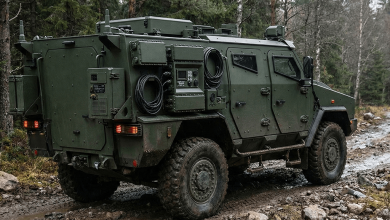
On the ground, systems like MUM-T are redefining the roles of military vehicles. The TERREX S5, weighing 35 tonnes gross and accommodating a crew of two plus ten troops, functions as a mobile command hub. It boasts impressive stats—120 km/h speed, a range of about 1,000 km, and the capability to navigate 60% gradients. The significance lies in operational application, as hybrid versions add a silent move capability and significantly increased onboard power. This power supports digital systems that provide comprehensive situational awareness, automated target tracking, and integrated systems for indirect fire or counter-UAS operations.

Mortar systems are also evolving. The Ground Deployed Advanced Mortar System (GDAMS) is lightweight and platform-agnostic. It can be rapidly deployed—typically within approximately 15 seconds with a small crew—and features digital controls, supporting both 81 mm and 120 mm tubes with impressive accuracy extending up to 9 km. To address concerns about noise, a blast diffuser significantly reduces the acoustic signature during operations.

According to an expert from ST Engineering, “When combined with counter-UAS systems like Adder, and leveraging a mix of radar, RF, and electro-optics, the emphasis is on effectively countering small drones and swarms. This was evident in numerous urban-focused demonstrations.”

Smart Maintenance, Repair, and Overhaul (MRO) is revolutionizing sustainment by incorporating digitalization, advanced analytics, and intelligent automation. This innovative approach enhances fleet availability, reduces ownership costs, and boosts operational efficiency. Additionally, remanufacturing and additive manufacturing capabilities are transforming supply-chain resilience, addressing obsolescence, and extending asset service life through localization. This strategy is in harmony with Saudi Vision 2030, which aims for 50% localization of military spending, a focus reinforced by the newly established Supply Chain Zone at defense events.

Training plays a crucial role in this process. AI-driven mixed reality tools—including Augmented Reality (AR), Virtual Reality (VR), and Extended Reality (XR)—are increasingly utilized for multitasking, vehicle operation, and tactical training. While these advancements may not seem immediately apparent, they are vital for facilitating cooperation among multinational forces, particularly in operational environments.

The progression towards smarter sustainment, unmanned systems, and adaptive protection is unmistakable. Digital transformation is accelerating sense-and-strike cycles, favoring forces that can disseminate information and support quicker than adversaries. This theme is integral to programs featured at prominent defense events throughout 2026. For land forces and their suppliers, like ST Engineering, the clear takeaway is that advantage will rely more on the integration of systems, personnel, and sustainment rather than on individual platforms for mission success.

Related Articles

Back to top button